AJ Wilson was the father of Uncle Alec, Isabel, Laura, Edwin Clement and Hew Anandale.
He wrote many books on economics, finance and investment and the following is an incomplete list: 'Practical Hints to Investors and Some Words to Speculators' (1897); 'The Business of Insurance (1904); and edited 'Colloquial Slang and Technical Terms in Use on the Stock Exchange and in the Money Market'; 'Reciprocity, Bi-metallism, and Land-tenure Reform'; 'The National Budget: The National Debt, Taxes and Rates'; 'Banking Reform: An Essay on Prominent Banking Dangers and the Remedies they Demand'.
He was editor of 'The Investor's Review'; 'Investment Index'; he also wrote an introductory note to 'Labour, Socialism and Strikes' by Yves Guyot (political editor of 'Le Siecle' and former Minister of Public Works in France). As far as I know, the only fiction he wrote was 'The Life of Thomas Wanless'. All in all, he seems to have been a very knowledgeable person regarding finances, economics and banking, and according to family rumours would have been Chancellor, had it not been for his "irregular birth".
AJ was the son of George Washington Wilson (GWW), who has his own Wikipedia page (https://en.wikipedia.org/wiki/George_Washington_Wilson) and is the subject of a book by Queen guitarist Brian May. GWW did not marry AJ's mother but they had 2 children together: AJ and Robert.
GWW then married someone else and her children went to live in New Zealand, a descendant of whom is Murray Wilson, who I met in 1993. Murray's wife Diane researched the descendants of GWW and she was made QSM in 2016 for services to genealogy and the community (https://gg.govt.nz/images/diane-wilson-auckland-qsm-services-genealogy-and-community).
There's an interesting blog about GWW photographs of South Africa here:
http://www.theheritageportal.co.za/article/george-washington-wilson-man-company-and-photographers
Saturday, 11 July 2020

Sunday, 5 July 2020
Hugh Wright b1831- d1911
This Hugh Wright was born at Alticry. He was the nephew of Duncan Wright (who left Kilmarnock for Monte Video and Buenos Ayres to make his fortune in commerce as an agent) and he inherited Alticry from Duncan.
Hugh married Irishwoman Margaret Bell (b1833 in Belford, Co Down, d1911). They were married on 12 Feb 1863 at Holywood, Co Down, Ireland and had Mary "Mimie", Duncan, Hugh "MacIntyre", Anne Campbell "Annie", Leslie, Dorothea "Dora", Graham Duncan and Angus, all born at Alticry.
When his uncle Duncan died, Hugh became a trustee of the Duncan Wright Endowment and set about investing money in land companies and stocks and shares. One of his investments was The Canada North-West Land Company (Limited), where in 1885 he was on the board of directors, amongh 11 others. Other investments included land in Bahia Blanca, to where he sent his son Hugh and land in the north of Argentina; to where he sent his son Leslie. I believe at this point of my research and could have to edit later, that his son Duncan was sent to Canada. Apologies for the confusing repetition of names down the generations - it is a tad confusing but I can't change that.
This Hugh Wright seems to have had some involvement with his local church because in a newspaper article of The Scotsman, March 1882, he is declared an Elder of the Wigtown Presbytery.
There is a lot to fill in of Hugh Wright's life and strife, but he lived the later part of his life in London in a house called Heidelberg on the King's Road in Clapham and later at Cornwall Mews, Kensington, where he died in 1911.
His son Hugh and he had such a falling out that his son took the drastic action of changing his name so as not to be associated to his father or brothers, so this is how my branch became MacIntyres.
Friday, 5 June 2020
Don Hugo/Pop (Hugh MacIntyre b1899-d1980)
Well, here we are in Covid-19 lockdown, so I'd better get on with this blog.


My granddad, Pop, as his daughters called him, was born at Estancia Los Mirasoles, Bahia Blanca. His parents emigrated to this farm from Alticry near Newton Steward in Dumfries and Galloway, Scotland.
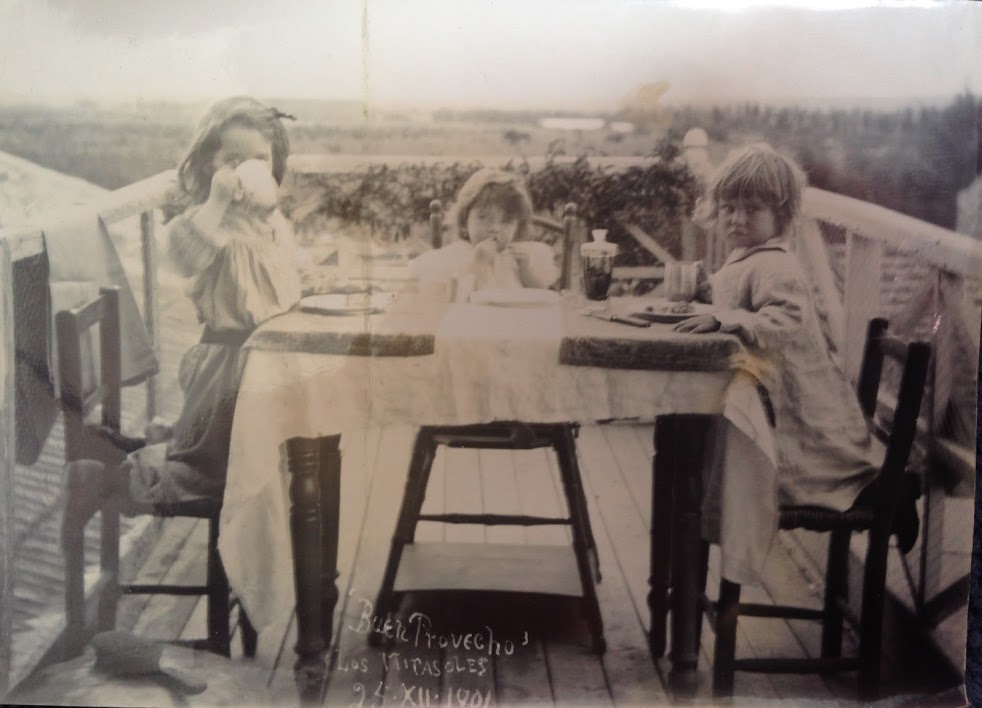 |
| Margarita, Bettie and Hugh on Christmas Day at Mirasoles, 1901 |
He was the second child and eldest boy of the family. For some reason he always looked very miserable in photos, but he was a most kind and gentle man. One of my only memories of him was one morning near Christmas when my advent calendar got torn in a sibling scrap and Granddad patiently glued the layers and pieces back together.
Photo
As in all large Victorian and Edwardian families, the siblings tended to separate into the "older ones" and the "younger ones" although they all remained very close even when scattered far and wide across the world. In order of age they were: Margarita (1897), Hugh (1899), Bettie (1900), Nancie (1903), Alastair (1910), Minona (1912) and Felicity (1913). There was a girl called Sheila (1908) who died before her 4th birthday.
Photo
At the tender age of 8 the young Hugh was sent across the ocean to Merchiston Castle boarding school in Edinburgh and became friends with two boys who would later become his brothers-in-law, Cecil and George Clark. As he was at school in Scotland, Hugh spent some of his school holidays at Alticry under the care of his aunts, Aunt Mamie, Aunt Annie and Aunt Dora and occasionally Cecil would come too.
Photo
In 19-----,the MacIntyres moved to Highmoor Hall in Henley-Upon Thames where
When the First World War began, Hugh was ----- and joined the --------. After training at ----- he was posted to ------- and after the war finished his ----- stayed in Belgium for a further ----- months.
Photos
After the war Hugh went to Clare College in Cambridge to study Botany and was in the Henley Regatta in 1921. He was also in one of the rugby teams. The Boat Race of that year was a great occasion for his family as they at that point had moved from Argentina to Henley-Upon-Thames, a house called Highmoor. Hugh's father had died (on the operating table in Buenos Aires of a burst appendix 1918) so his mother had moved the family back to the UK.
Wednesday, 26 February 2020
Aunt Dora
In we go. “This should be interesting” I hear the family think - well, I hope it will be once I’ve got more than the bare bones down. I’ll add as I find things out, so this blog will be updated and changed.
Dora Wright was in 1873 in Mochrum, Wigtownshire, Scotland, probably at Alticry House. Her father was Hugh Wright (b.1831- d.1911) and Margaret Bell (b.1833 - d.1911). According to the UK Census on 3 April 1881 she was aged 8 and living at Alticry. She had two older sisters (Mary and Annie) and 5 brothers (Duncan, Hugh, Leslie, Graham and Angus)
All very hum-drum so far, but then surprisingly, I found that she was sent as a teen to school in Schleswig-Holstein in the town of Glucksburg, the most northernmost German settlement near the Danish border. Why would a Scottish family send their youngest daughter there?
Anyway, her dream was to study medicine at Cambridge, and I have a receipt for an entrance exam, so she did go.
The next document I have is of a St John’s Ambulance certificate.
There’s also a Beekeeper’s Certificate.
Dora Wright was in 1873 in Mochrum, Wigtownshire, Scotland, probably at Alticry House. Her father was Hugh Wright (b.1831- d.1911) and Margaret Bell (b.1833 - d.1911). According to the UK Census on 3 April 1881 she was aged 8 and living at Alticry. She had two older sisters (Mary and Annie) and 5 brothers (Duncan, Hugh, Leslie, Graham and Angus)
All very hum-drum so far, but then surprisingly, I found that she was sent as a teen to school in Schleswig-Holstein in the town of Glucksburg, the most northernmost German settlement near the Danish border. Why would a Scottish family send their youngest daughter there?
 |
| This photo was in Aunt Dora’s belongings. Presumably it is of the school. |
Anyway, her dream was to study medicine at Cambridge, and I have a receipt for an entrance exam, so she did go.
The next document I have is of a St John’s Ambulance certificate.
There’s also a Beekeeper’s Certificate.
Sunday, 26 January 2020
Burns Night
It was Rabbie Burns' birthday yesterday and it looks like one of the Hugh Wrights really enjoyed Burns Night dinners. Here's a clipping from the Strathearn Herald but a similar recount also appeared in the Dundee Advertiser, January 1886.

It reads:
ONE WHO DANCED WITH BURNS. - At a meeting of the London Burns Club on Monday night, Mr Hugh Wright of Alticry said that within the last twenty years he had spoken to an old lady who had danced with Burns at his [Burns's] brother's marriage. Burns was very hearty, and as he and his partner were careering round the room the poet upset the table which contained the bride's china.
I believe this was Hugh Wright, Born 1831 in Mauchline, Ayrshire, Scotland. Burns' wife was from Mauchline, and although Rabbie died in 1796, this story is entirely possible. According to visitscotland.com, the period of time Burns lived in Mauchline was "arguably his most creative and productive period".

It reads:
ONE WHO DANCED WITH BURNS. - At a meeting of the London Burns Club on Monday night, Mr Hugh Wright of Alticry said that within the last twenty years he had spoken to an old lady who had danced with Burns at his [Burns's] brother's marriage. Burns was very hearty, and as he and his partner were careering round the room the poet upset the table which contained the bride's china.
I believe this was Hugh Wright, Born 1831 in Mauchline, Ayrshire, Scotland. Burns' wife was from Mauchline, and although Rabbie died in 1796, this story is entirely possible. According to visitscotland.com, the period of time Burns lived in Mauchline was "arguably his most creative and productive period".
Thursday, 9 January 2020
New Year, new post! Happy 2020
New Year, new post! I haven't written for a while, so although I haven't made much tangible progress, I thought I'd jot down what I've been up to.
I've signed up to findmypast.co.uk for a year. Too late to change, but there are other, more interactive sites out there where you can communicate with other genealogy aficionados and share knowledge - you can't on this one. However, I have access to a lot of records now which I didn't before, so I'm making the most of it, although this easy access has caused my concentration to dissipate, so I'm all over the place.
I've been looking at my husband's side of the family and found some interesting stories - a combination of legal records and family stories sometimes throw up inconsistencies and more questions than answers, eg why is it recorded in the divorce record that there were no children, when there clearly was a child?! This will require more digging, which I'm happy about as I like a mystery.
It being the season of Christmas and New Year, it's been rather quiet at work, so I have aided a couple of my colleagues in their family history search, which has been very satisfying, throwing light on the offhand mentions by relatives. For example, a father sent his daughter away to live with relatives, while keeping her younger siblings at home; it turns out the child was the daughter of another man - the first husband. This story was particularly poignant for my colleague, the child in question being her mother, who had all her life wondered why she was not wanted, but unfortunately had died the previous month.
A lot of time is taken up by learning history! So much more can be added to genealogy by knowing the context of the lives being studied. I've learned about the Cisplatine War (1825-1828), especially relevant to Hugh Wright's life as an agent, stuck in Montevideo between the warring Argentina and Brazil (hopping across the River Plate when trade was more profitable on the other side). I've learned about the importance of the deep waters of the port of Montevideo as opposed to the shallow Buenos Aires, the treacherous sand banks in the River Plate which played havoc with trade vessels laden with cargo from Europe. Imagine crossing the Atlantic Ocean, north to south, only to get stranded on a sandbank a mile or so from your destination!
Also, I've learned about the precariousness of life in the early C19 and the provision of charity (or lack thereof) among family members from those who have "made it" to those who find themselves in difficult situations. I don't know how much charity was socially accepted to ask for or receive, but at a time that conferred so much importance to appearance, it must have been difficult to swallow one's pride and ask. As illustration I will transcribe a letter from Bruce Wright at 23 Baker's Hill, Sheffield, to Duncan Wright (of Wright, Parlane &Co) in Manchester dated Sept 1842:
Dear Cousin,
Not having heard from you in answer to my former letter I presume it's not your intention to make any reply. I beg you will allow me to say a few words. I would not write did not a bruised body call loudly for some assistance. I have now been confined to bed for two months - and many more must elapse before I can earn a shilling. Under these circumstances any help will be of greatest consequence - may I hope a farthing from you will not be withheld.
I am
your cousin
Yours affectionately
Bruce Wright

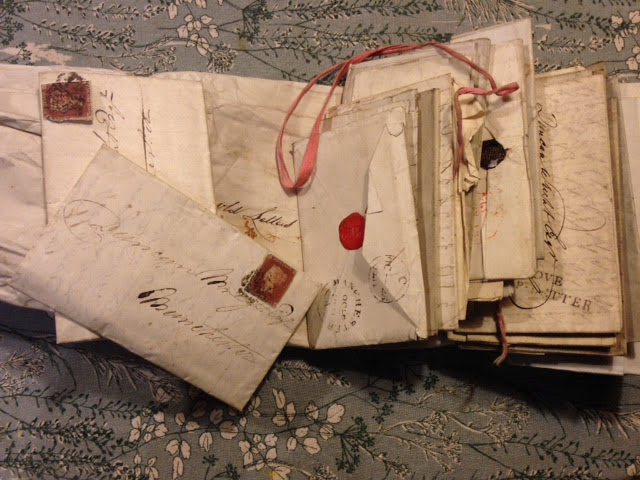
Having read a few of the letters in the "Old Letters" bundle, it seems quite a few of them are from relatives asking for help or money. Some are letters of introduction/recommendation but very few are of the family conversation type, which makes me think that they have been carefully selected to be kept together as evidence, to be used if needed. Who selected them and for what purpose, who knows?
I've signed up to findmypast.co.uk for a year. Too late to change, but there are other, more interactive sites out there where you can communicate with other genealogy aficionados and share knowledge - you can't on this one. However, I have access to a lot of records now which I didn't before, so I'm making the most of it, although this easy access has caused my concentration to dissipate, so I'm all over the place.
I've been looking at my husband's side of the family and found some interesting stories - a combination of legal records and family stories sometimes throw up inconsistencies and more questions than answers, eg why is it recorded in the divorce record that there were no children, when there clearly was a child?! This will require more digging, which I'm happy about as I like a mystery.
It being the season of Christmas and New Year, it's been rather quiet at work, so I have aided a couple of my colleagues in their family history search, which has been very satisfying, throwing light on the offhand mentions by relatives. For example, a father sent his daughter away to live with relatives, while keeping her younger siblings at home; it turns out the child was the daughter of another man - the first husband. This story was particularly poignant for my colleague, the child in question being her mother, who had all her life wondered why she was not wanted, but unfortunately had died the previous month.
A lot of time is taken up by learning history! So much more can be added to genealogy by knowing the context of the lives being studied. I've learned about the Cisplatine War (1825-1828), especially relevant to Hugh Wright's life as an agent, stuck in Montevideo between the warring Argentina and Brazil (hopping across the River Plate when trade was more profitable on the other side). I've learned about the importance of the deep waters of the port of Montevideo as opposed to the shallow Buenos Aires, the treacherous sand banks in the River Plate which played havoc with trade vessels laden with cargo from Europe. Imagine crossing the Atlantic Ocean, north to south, only to get stranded on a sandbank a mile or so from your destination!
Also, I've learned about the precariousness of life in the early C19 and the provision of charity (or lack thereof) among family members from those who have "made it" to those who find themselves in difficult situations. I don't know how much charity was socially accepted to ask for or receive, but at a time that conferred so much importance to appearance, it must have been difficult to swallow one's pride and ask. As illustration I will transcribe a letter from Bruce Wright at 23 Baker's Hill, Sheffield, to Duncan Wright (of Wright, Parlane &Co) in Manchester dated Sept 1842:
Dear Cousin,
Not having heard from you in answer to my former letter I presume it's not your intention to make any reply. I beg you will allow me to say a few words. I would not write did not a bruised body call loudly for some assistance. I have now been confined to bed for two months - and many more must elapse before I can earn a shilling. Under these circumstances any help will be of greatest consequence - may I hope a farthing from you will not be withheld.
I am
your cousin
Yours affectionately
Bruce Wright
Having read a few of the letters in the "Old Letters" bundle, it seems quite a few of them are from relatives asking for help or money. Some are letters of introduction/recommendation but very few are of the family conversation type, which makes me think that they have been carefully selected to be kept together as evidence, to be used if needed. Who selected them and for what purpose, who knows?
Saturday, 16 November 2019
Arts and Crafts - Bonner, Wright
I've often wondered about Uncle Bertie and Aunt Mamie. I had many questions
about them: How did Albert Edward Bonner, Arts and Crafts artist, enameller
and silversmith
(Uncle Bertie b.1862) meet Aunt Mamie (Mary Wright b.1860)?
They were married in Chelsea in 1912 when already in their 50s. Had they
known each other for a long time before they tied the knot? What did they
see in each other?
 12 February 1912 - London Standard Newspaper Archives, p.9 - Mr Albert Bonner, of 17 Gordon Place, Kensington, youngest son of the
late Mr. Henry Calthorpe Bonner, was married on Saturday, at St
Columba’s Pont Street, to Miss Mary Wright, eldest daughter of the
late Mr Hugh Wright, of Alticry, Wigtownshire, and Blackburn,
Berwickshire. ... Miss Dora Wright was her sister’s only attendant,
and wore a dress of amethyst Liberty crepe, the fetching bodice being
finished with a bunch of purple pansies. She also wore a large picture
hat, and carried a bouquet of pink carnations, which, with an amethyst
necklet and pendant, was the bridegroom’s gift. Mr Arthur Cheatle was
best man.
12 February 1912 - London Standard Newspaper Archives, p.9 - Mr Albert Bonner, of 17 Gordon Place, Kensington, youngest son of the
late Mr. Henry Calthorpe Bonner, was married on Saturday, at St
Columba’s Pont Street, to Miss Mary Wright, eldest daughter of the
late Mr Hugh Wright, of Alticry, Wigtownshire, and Blackburn,
Berwickshire. ... Miss Dora Wright was her sister’s only attendant,
and wore a dress of amethyst Liberty crepe, the fetching bodice being
finished with a bunch of purple pansies. She also wore a large picture
hat, and carried a bouquet of pink carnations, which, with an amethyst
necklet and pendant, was the bridegroom’s gift. Mr Arthur Cheatle was
best man.
They moved from London to Scotland and lived at Mary's family home of Alticry, visiting France at least once - there's a photo of them all at a fancy dress party in France and Bertie is in a head-to-toe bird costume, which had the photo not been captioned on the back, he would be completely unrecognisable. A couple of times a year from 1923 they holidayed in Bath and after Mamie died Bertie continued to go on his own until 1931.
Surmising from the extract of The Art Journal below, I believe he learnt his skills at the London County Council Central School. His AEB hallmark was first registered in the London Guild in 1905
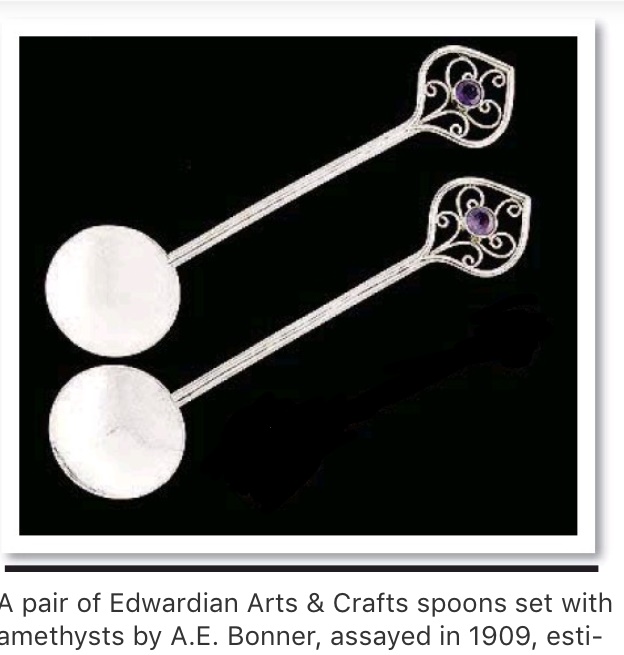
Here are the most accomplished examples I could find on the internet of his enamel work and some of his spoons. He also made remarkable bowls.

In trying to satisfy my curiosity, I did a little internet research and was
much encouraged by finding an
article
written in November 2019 by
Anthony Bernbaum
of
The Pear Tree Collection
in London. The web page says "Based on the absence of hallmarked Bonner pieces
after c1918 it is assumed he retired from metalwork at that time".
What was his relationship with Mamie's sister, Aunt Dora, who also lived at Alticry and was an accomplished metal worker and designer. Was she his pupil or did she learn her skill earlier? Aunt Dora deserves a write-up all of her own as she was quite a character - the stuff of family legend.
Below is a photo of the three of them in the Alticry garden, Bertie on the ground, surrounded by friends c1916.

Since I first wrote this blog in November 2019, we as a family have a higher appreciation of AEB's work and how lucky we are to have him as part of our story. My sister-in-law has kindly been researching to see if we have overlooked anything and found two additional items which belonged to AEB: his cigarette case (not made by him) and an inkwell of his own creation.
If you want to learn more about the Arts and Crafts movement, here is an interesting and educational video.
Below is my own research. If you would like to use it, please quote this blog. CEH.

|
| Mary Wright |
 12 February 1912 - London Standard Newspaper Archives, p.9 - Mr Albert Bonner, of 17 Gordon Place, Kensington, youngest son of the
late Mr. Henry Calthorpe Bonner, was married on Saturday, at St
Columba’s Pont Street, to Miss Mary Wright, eldest daughter of the
late Mr Hugh Wright, of Alticry, Wigtownshire, and Blackburn,
Berwickshire. ... Miss Dora Wright was her sister’s only attendant,
and wore a dress of amethyst Liberty crepe, the fetching bodice being
finished with a bunch of purple pansies. She also wore a large picture
hat, and carried a bouquet of pink carnations, which, with an amethyst
necklet and pendant, was the bridegroom’s gift. Mr Arthur Cheatle was
best man.
12 February 1912 - London Standard Newspaper Archives, p.9 - Mr Albert Bonner, of 17 Gordon Place, Kensington, youngest son of the
late Mr. Henry Calthorpe Bonner, was married on Saturday, at St
Columba’s Pont Street, to Miss Mary Wright, eldest daughter of the
late Mr Hugh Wright, of Alticry, Wigtownshire, and Blackburn,
Berwickshire. ... Miss Dora Wright was her sister’s only attendant,
and wore a dress of amethyst Liberty crepe, the fetching bodice being
finished with a bunch of purple pansies. She also wore a large picture
hat, and carried a bouquet of pink carnations, which, with an amethyst
necklet and pendant, was the bridegroom’s gift. Mr Arthur Cheatle was
best man.
They moved from London to Scotland and lived at Mary's family home of Alticry, visiting France at least once - there's a photo of them all at a fancy dress party in France and Bertie is in a head-to-toe bird costume, which had the photo not been captioned on the back, he would be completely unrecognisable. A couple of times a year from 1923 they holidayed in Bath and after Mamie died Bertie continued to go on his own until 1931.

|
|
Albert Edward Bonner's bible, given to him by his godfather John Barker |
When Mamie and Bertie's nephew Hugh MacIntyre moved from Uruguay into
Alticry in 1963/4, he returned some of Bertie's personal possessions that
were still in the house, tools, letters, etc. to the Bonner family. Bertie had long since died in 1943, having lived his widower days in the
house he bought in 1927 in Freshford, Limpley Stoke near Bath. He was
the tenth and youngest child of Henry Calthrop Bonner and his wife Susan
Ellen Freeman, farmers from East Rudham in Norfolk.

|
| Bertie sawing wood at Alticry front door. |
Surmising from the extract of The Art Journal below, I believe he learnt his skills at the London County Council Central School. His AEB hallmark was first registered in the London Guild in 1905
December 1906 - The Art Journal
- The Arts And Crafts Exhibition II -
”Of the school-work, detailed notice would be out of proportion. Here one looks for the evidence of the Arts and Crafts teaching to be shown in a level of conscientious and well-directed work, rather than in special evidence of originality. Some of the work noticed in detail in the foregoing notice, as Mr. Bonner’s pendant, and the delicately embroidered linen frock of Miss Lessore, was part of
”Of the school-work, detailed notice would be out of proportion. Here one looks for the evidence of the Arts and Crafts teaching to be shown in a level of conscientious and well-directed work, rather than in special evidence of originality. Some of the work noticed in detail in the foregoing notice, as Mr. Bonner’s pendant, and the delicately embroidered linen frock of Miss Lessore, was part of
the last students’ exhibition at the L.C.C. Central School."
Here are the most accomplished examples I could find on the internet of his enamel work and some of his spoons. He also made remarkable bowls.

Enamel picture on the lid of a silver playing card box 1912.
|
|
|

|
| Six-legged bowl, 1907. Photo by Marlin Antiques. |
What was his relationship with Mamie's sister, Aunt Dora, who also lived at Alticry and was an accomplished metal worker and designer. Was she his pupil or did she learn her skill earlier? Aunt Dora deserves a write-up all of her own as she was quite a character - the stuff of family legend.
Below is a photo of the three of them in the Alticry garden, Bertie on the ground, surrounded by friends c1916.

Since I first wrote this blog in November 2019, we as a family have a higher appreciation of AEB's work and how lucky we are to have him as part of our story. My sister-in-law has kindly been researching to see if we have overlooked anything and found two additional items which belonged to AEB: his cigarette case (not made by him) and an inkwell of his own creation.

|
| AEB's cigarette case |

|
| Inkwell with clear glass insert. |
If you want to learn more about the Arts and Crafts movement, here is an interesting and educational video.
Below is my own research. If you would like to use it, please quote this blog. CEH.
Albert Edward Bonner (b. May 1862 - d. 13 September 1943)
11 June 1862 - CEH Personal Collection - Baptised in East Rudham, Norfolk. Godfather John Barker gave him
a bible.
2 April 1871 - Census UK - Son of the head of the household. Aged 8. Lynn Road, East Rudham,
Docking, Norfolk.
3 April 1881 - Census UK - Son of the head of the household. Aged 18. Fakenham Manor House,
East Rudham, Docking, Norfolk.
20 April 1889 - Thetford & Watton Times and People’s Weekly Journal, p.6 - Terrible boiler explosion at Rudham. An inquest was opened and AE
Bonner represented his father HC Bonner who was too ill to be
present.
5 April 1891 - Census UK
- Son of the head of the household. Aged 28. Syderstone, Docking,
Norfolk.
16 November 1891 - Eastern Daily Express - Trades and Industrial Exhibition at Lynn - “Among the carvings
one of the most noticeable entries is a carved grandfather’s clock case,
for which Albert E. Bonner of East Rudham justly earns a bronze medal”.
198 entries for medals.
21 November 1891 - Norfolk News - as above.
1896 - The Studio. An Illustrated Magazine of Fine and Applied Art. Vol. 6
- “Mr Fred Collcott and Mr AE Bonner will hold Day Classes for pupils at
the Studio, 18 Rochester Road, …”
22 July 1898 - The Essex County Chronicle, p.7 - Lectern in oak presented by Mr Rayner and her daughters in memory
of Mr Bromley Rayner and a pulpit in memory of Rector Rev SW Waud were
both executed by AE Bonner of Hawick, NB (Rettendon Church). [Not sure if this is our AEB]
11 November 1898 - Western Daily Press
- Bristol and Clifton Arts and Crafts Society Annual Exhibition - “The
best piece of wood carving is a small panel by Albert Bonner. It sums up
all the qualities which the others lack, except, perhaps, originality.
Considering its difficult character it is remarkably well executed, and is
an example of wood carvers in general”.
26 October 1899 - Carving night classes advertised in Edinburgh.
27 February 1900 - Exhibition of works from students of the Edinburgh
Arts and Crafts Club.- “Corner cupboards, tables, mirror frames, etc.
Panels in different styles of carving and in different woods by Mr. Albert
E. Bonner were characterised by delicacy of design and perfection of
workmanship”.
6 December 1901 - Exhibition in Bath where he says one of his “rules is
never to make two articles - unless of course they form part of a set -
exactly alike.” His beaten silver bowls, pepper pots, spoons and so forth,
make a very interesting display.
27 December 1902 - Gallery 1, Princes Terrace, Hereford Road, Bayswater.
Exhibition of Applied Arts organised by AE Bonner and John Baillie.
Artists included WS Headaway, Mr and Mrs Arthur Cave Gaskin, Mr Herbert
Carr, Mrs Arthur Mure, Miss Ethel Virtue, Miss Eva Nelson, Miss Maclaren,
Miss Eleanor Rowe, Miss ME Reeks, the Chiswick Art Worker’s Guild, the
Kilarney Furniture Industries, Mr Walter Crane and Mrs Walter Crane
(embroideries), Mr Alexander Fisher (enamels), Miss Ridley (guilded
frames) Lady Alix (decorated books).
1903 - The Academy and Literature, Vol.3 p.641 - Advert for “Exhibition of Modern Work, Jewellery, Enamel,
Embroidery & C. 1 Princes Road, W. John Baillie and AE Bonner.
10 March 1903 - The London Gazette
- Baillie & Bonner dissolved.
1904 - The Athenaeum, p.557 - “The Exhibition of the Royal Society of British Artists in
Suffolk Street is now open. Mr. AE Bonner opens next Monday at 18 Holland
Street, Kensington, an Exhibiiton of Hand Weaving by Miss C Brown, Miss E
Chapman and Miss EJ Colling”.
1905 - Exhibition of Applied Arts at 18 Holland Street, Kensington. “His
own work includes some excellent jewellery, particularly one would mention
a necklet of amethystine coloured enamels and pearls, and two pendants in
the same cane, one with opals and the other with enamels. A chatelaine of
enamelled silver is well designed, and some small articles of table
furniture are also good”.
22 November 1905 - Directory of Gold and Silversmiths, Jewellers and Allied by John Culme, 2000. - AEB hallmark first recorded. Address given
was 18 Holland Street. Artist. [London Guild]
1906 - The Burlington Magazine for Connoisseurs Vol. 8
- “AE Bonner. Exhibition of Enamels, Jewellery, Leather Work …”
December 1906 - The Art Journal
- The Arts And Crafts Exhibition II -
”Of the school-work, detailed notice would be out of proportion. Here one looks for the evidence of the Arts and Crafts teaching to be shown in a level of conscientious and well-directed work, rather than in special evidence of originality. Some of the work noticed in detail in the foregoing notice, as Mr. Bonner’s pendant, and the delicately embroidered linen frock of Miss Lessore, was part of
”Of the school-work, detailed notice would be out of proportion. Here one looks for the evidence of the Arts and Crafts teaching to be shown in a level of conscientious and well-directed work, rather than in special evidence of originality. Some of the work noticed in detail in the foregoing notice, as Mr. Bonner’s pendant, and the delicately embroidered linen frock of Miss Lessore, was part of
the last students’ exhibition at the L.C.C. Central School.
What is shown in the school cases, and in the carved frames, clocks and fine cabinet-making sent from various craft-schools, is
the preparation for independent work in some cases, and, in all, a
discipline that is the best procurable substitute in modern life for the
teaching that filled and shaped the whole life of the guild-apprentice
when art glorified industry. The London County Council schools and
classes, the Birmingham Schools, the Sir John Cass Institute, and the
Northampton Institute are chief among the schools whose exhibits in the
various crafts confirm the claim for the effective action of the Arts and
Crafts in teaching. The elaborately-wrought covered cup by Mr. Toms (p.
124), the inlaid clock from the L.C.C. Central School (p. 122), the
embroidery from Birmingham, (p. 127), are examples of what is being done.” https://archive.org/stream/gri_33125006187831/gri_33125006187831_djvu.txt
Sat. December 1908 - The Athenaeum, p.769 - “Mr AE Bonner’s Exhibition of Silver Spoons, Pepperpots &c,
and Enamels, Jewellery …”
9 December 1908 - Directory of Gold and Silversmiths, Jewellers and Allied by John Culme, 2000. - AEB recorded as at 17 Gordon Place,
Kensington, W.
1909 - May have collaborated with Henry Wilkinson Colinson.
December 1901 - The Art Journal
- London Exhibitions - Albert E Bonner. https://archive.org/stream/gri_33125006187864/gri_33125006187864_djvu.txt
2 April 1911 - Census UK
- Head of the household. Aged 49. 17 Gordon Place, Kensington, W. Had 3
visitors in the house and 2 servants. Occupation Artist, Metal Work. (The
Applied Arts Centre).
12 October 1911 - The Bath Chronicle
- Exhibition of Arts and Crafts and Women’s Work at the Assembly Rooms,
Bath. “Mr Albert E Bonner of Kensington, London, shows once more a
fascinating collection of dainty silverware and jewellery. These goods are
manufactured from beaten silver and the wide range of designs is quite
remarkable. Mr Bonner prides himself in his originality in this respect,
and in his ornamentation he unquestionably displays great fertility of
resource”.
10 February 1912 - Married Mary Wright of Alticry (b. 17 December 1863 -
d.
12 February 1912 - London Standard Newspaper Archives, p.9 - Mr Albert Bonner, of 17 Gordon Place, Kensington, youngest son
of the late Mr. Henry Calthorpe Bonner, was married on Saturday, at St
Columba’s Pont Street, to Miss Mary Wright, eldest daughter of the late
Mr Hugh Wright, of Alticry, Wigtownshire, and Blackburn, Berwickshire.
... Miss Dora Wright was her sister’s only attendant, and wore a dress
of amethyst Liberty crepe, the fichn bodice beix^ finished with a bunch
of purple pansies. She also wore a large picture hat, and carried a
bouquet of pink carnations, which, with an amethyst necklet and pendant,
was the bridegroom’s gift. Mr Arthur Choalle [?] was best man.
6 August 1921 - Bath Chronicle
- Limpley Stoke Show. 1st prize Collection of honey: Mr AE Bonner (H. Holley).
20 January 1923 - Bath Chronicle
- Bath Visitors’ List. Mr Bonner (Wigtownshire).
10 and 22 November 1923 - Bath Chronicle
- Bath Visitors’ List. Mr & Mrs Bonner (Alticry, Elrig,
Wigtownshire).
18 and 25 October 1924 - Bath Chronicle
- Bath Visitors’ List. Mr & Mrs Bonner (Port William,
Wigtownshire).
1927 - Somerset Architects index
- 1927 House, Freshford, Som for AE Bonner; RIBAD; ?same house as
Freshfords, Limpley Stoke file CrA/14/3
6 August 1927 - Bath Chronicle
- Bath Visitors’ List. Mr A Bonner (Scotland).
17 May 1930 - Bath Chronicle
- Bath Visitors’ List. Mr Bonner (Wigtownshire).
30 August 1930 - Bath Chronicle
- Bath Visitors’ List. Mr Bonner (Wigtownshire).
31 January 1931 - Bath Chronicle
- Bath Visitors’ List. Mr Bonner (Limpley Stoke).
23 October 1936 - CEH Personal Collection - Recorded in the diary of KM Clark. “Mr Bonner here for weekend”.
AEB went to visit KM Clark at Clemsfold, Horsham before she travelled to
Uruguay to get married to AEB’s nephew, Hugh MacIntyre (Wright).
May 1939 - HCWH Personal Collection - a magazine with AEB’s signature and his handwriting, so still
alive.
29 September 1939 - 1939 Register
- Trinity Marian Hotel, Clifton, Eastbourne, Sussex. Retired artist,
widowed.
13 September 1943 - Albert Edward Bonner died.
24 November 1943 - The Scotsman
- Gross estate at death of £5,617.
27 November 1943 - Bath Weekly Chronicle
- Probate granted to Arthur Render of Farnley Close, Peaslake, Guildford,
Surrey and Maurice B Bird of Little Belstead, Little Watham, Chelmsford,
Essex, nephews.
1963/4 - When the MacIntyres of Uruguay moved into Alticry they returned
most of AEB’s personal possessions, tools, letters, etc to his
family.


Subscribe to:
Posts (Atom)